Inspectial
- Inspectial
- Free checklists
- Lead service lines
Lead service line inventory template and field checklist
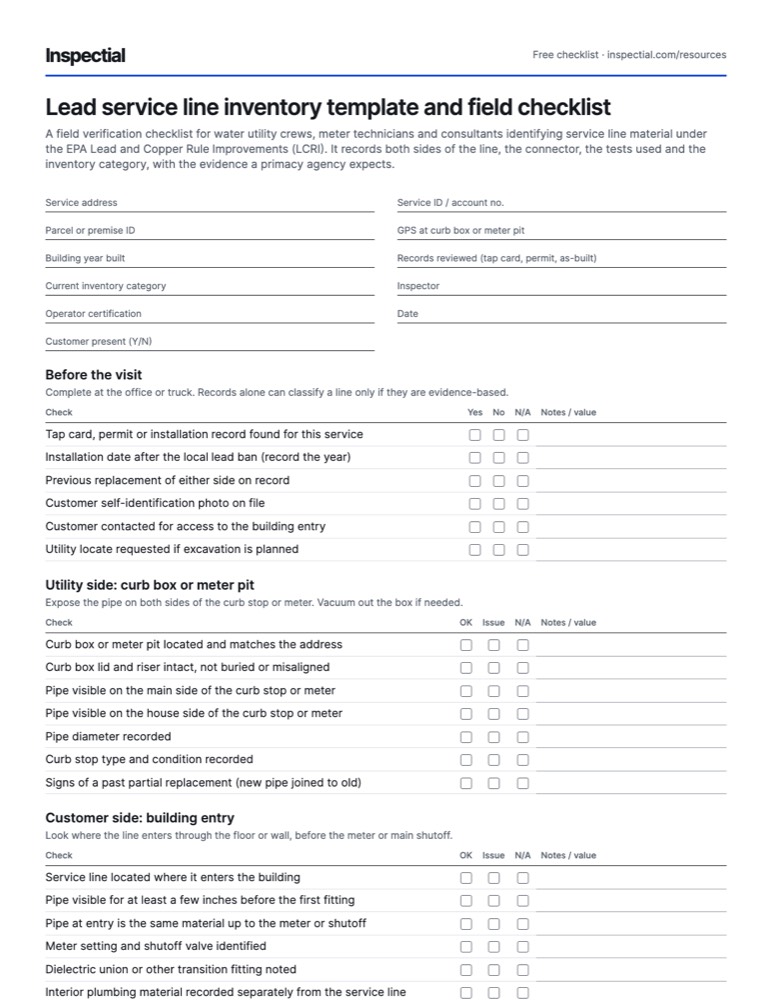
A field verification checklist for water utility crews, meter technicians and consultants identifying service line material under the EPA Lead and Copper Rule Improvements (LCRI). It records both sides of the line, the connector, the tests used and the inventory category, with the evidence a primacy agency expects.
What is a lead service line inventory checklist?
A lead service line inventory checklist is a field form for identifying what a water service line is made of and classifying it for the EPA inventory. The inspector checks the utility-owned and customer-owned portions, any lead connector, and test results such as the scratch and magnet test, then assigns lead, galvanized requiring replacement, non-lead or lead status unknown.
When to inspect
Under the LCRI (40 CFR 141.84), water systems must submit a baseline inventory including connectors by November 1, 2027, update it every year after that, and identify the material of every lead status unknown line by their replacement deadline, December 31, 2037 for most systems. Field checks also happen during meter replacement, main work, customer requests and inventory validation, which requires visual inspection at a minimum of two points on sampled non-lead lines.
The checklist
Every row is one observable check. Mark one answer per row and write what you saw or measured; the PDF adds a findings table and sign-off.
Header
- Service address
- Service ID / account no.
- Parcel or premise ID
- GPS at curb box or meter pit
- Building year built
- Records reviewed (tap card, permit, as-built)
- Current inventory category
- Inspector
- Operator certification
- Date
- Customer present (Y/N)
Before the visit
Complete at the office or truck. Records alone can classify a line only if they are evidence-based.
| Check | Yes | No | N/A | Notes / value |
|---|---|---|---|---|
| Tap card, permit or installation record found for this service | ||||
| Installation date after the local lead ban (record the year) | ||||
| Previous replacement of either side on record | ||||
| Customer self-identification photo on file | ||||
| Customer contacted for access to the building entry | ||||
| Utility locate requested if excavation is planned |
Utility side: curb box or meter pit
Expose the pipe on both sides of the curb stop or meter. Vacuum out the box if needed.
| Check | OK | Issue | N/A | Notes / value |
|---|---|---|---|---|
| Curb box or meter pit located and matches the address | ||||
| Curb box lid and riser intact, not buried or misaligned | ||||
| Pipe visible on the main side of the curb stop or meter | ||||
| Pipe visible on the house side of the curb stop or meter | ||||
| Pipe diameter recorded | ||||
| Curb stop type and condition recorded | ||||
| Signs of a past partial replacement (new pipe joined to old) |
Customer side: building entry
Look where the line enters through the floor or wall, before the meter or main shutoff.
| Check | OK | Issue | N/A | Notes / value |
|---|---|---|---|---|
| Service line located where it enters the building | ||||
| Pipe visible for at least a few inches before the first fitting | ||||
| Pipe at entry is the same material up to the meter or shutoff | ||||
| Meter setting and shutoff valve identified | ||||
| Dielectric union or other transition fitting noted | ||||
| Interior plumbing material recorded separately from the service line |
Material identified at each point
Mark one material per row. Galv. = galvanized iron or steel.
| Check | Lead | Galv. | Copper | Plastic | Unknown | Notes / value |
|---|---|---|---|---|---|---|
| Utility side, main side of the curb stop or meter | ||||||
| Utility side, house side of the curb stop or meter | ||||||
| Customer side, at the building entry | ||||||
| Pipe exposed by potholing or excavation (record location) |
Identification tests
Scratch gently with a coin or key, never a sharp tool. Photograph each result.
| Check | Yes | No | N/A | Notes / value |
|---|---|---|---|---|
| Scratch test done at each visible point | ||||
| Scratched area soft and shiny silver (indicates lead) | ||||
| Scratched area penny-colored (indicates copper) | ||||
| Magnet sticks to the pipe (indicates galvanized or iron) | ||||
| Wiped, bulb-shaped joint present (indicates lead) | ||||
| Threaded joints present (indicates galvanized) | ||||
| Plastic with printed markings recorded (type and rating) | ||||
| Lead test swab or kit used, with result |
Connector (gooseneck or pigtail)
The short flexible section between the main and the service line. Record it separately from the line.
| Check | Lead | Non-lead | Unknown | None | Notes / value |
|---|---|---|---|---|---|
| Connector material at the main, from excavation or records | |||||
| Short flexible segment at the curb stop or meter setting |
Classification and evidence
| Check | Yes | No | N/A | Notes / value |
|---|---|---|---|---|
| Material confirmed at two or more points on the line | ||||
| At least one point inspected on each side where ownership is shared | ||||
| Galvanized line is or ever was downstream of lead or an unknown | ||||
| Photo of every inspected point with the scratch or magnet result | ||||
| Identification method recorded (records, visual, CCTV, excavation, model) | ||||
| Inventory category assigned for the utility and customer sides | ||||
| Line remains lead status unknown and needs a follow-up method | ||||
| Customer notified of a lead, GRR or unknown result |
Inventory classification (40 CFR 141.84)
- Non-lead
- Shown through an evidence-based record, method or technique not to be lead or galvanized requiring replacement.
- Lead status unknown
- Material not yet demonstrated. A line stays here until the evidence supports a category.
- Galvanized requiring replacement (GRR)
- Galvanized that is or ever was downstream of a lead line, or is now downstream of an unknown line.
- Lead
- Made of lead, in whole or in part. A lead-lined galvanized line counts as lead.
Photos to take
- House front with the address number visible
- Curb box or meter pit location, wide shot
- Pipe on each side of the curb stop or meter
- Pipe at the building entry with the floor or wall visible
- Scratch test result at each point, close up
- Magnet test at each point, showing whether it sticks
- Any wiped joint, union or transition fitting
Field tips
- Record the utility and customer sides separately; a copper customer side over a lead utility side is still a lead service line.
- Watch for partial replacements: a short new section at the curb stop can sit on top of old lead pipe.
- Galvanized pipe is magnetic and hard to scratch; lead is non-magnetic, soft and scratches shiny silver.
- Don't confuse interior plumbing with the service line; identify the pipe where it first enters the building.
- Photograph each test result in place, with the pipe and fitting in frame, so a reviewer can accept it without a revisit.
- If you can't see the pipe, leave the line as lead status unknown and record why, rather than guessing from the neighbors.
- Use a GPS fix or block and landmark when there is no street address; the inventory accepts a unique location identifier.
Standards and sources
Checked against these sources on . Your agency's own manual takes precedence.
Questions
How do you identify a lead service line?
Lead pipe is dull gray, soft, scratches to a shiny silver with a coin or key, and a magnet won't stick to it. It is often joined with a bulb-shaped wiped joint. Galvanized pipe is also gray but magnetic and hard to scratch, copper scratches to a penny color, and plastic is smooth and colored.
What are the four service line inventory categories?
Under the LCRI, each service line is classified as lead, galvanized requiring replacement, non-lead or lead status unknown. Connectors are classified separately as lead, non-lead, unknown or no connector present. Where ownership is shared, both the utility-owned and customer-owned portions are inventoried.
What is a two-point visual inspection?
It is a visual inspection of the pipe exterior at a minimum of two points on the service line. Under 40 CFR 141.84, systems use it to validate a random sample of non-lead lines, and where ownership is shared at least one point must be on each portion. Non-lead lines identified by a two-point inspection, installation date records or replacement are excluded from the validation pool.
What is galvanized requiring replacement?
A galvanized iron or steel service line that is or ever was downstream of a lead service line, or is currently downstream of a lead status unknown line. These lines must be replaced along with lead lines, because galvanized pipe can collect lead released from upstream lead pipe.
When is the LCRI service line inventory due?
The initial inventory was due October 16, 2024 under the LCRR. Under the LCRI, the baseline inventory including connectors is due November 1, 2027, with annual updates after that. Most systems must identify the material of every unknown line by December 31, 2037.
Do this inspection on your phone: AI drafts it, you approve
Inspectial turns the photos, voice notes and GPS from this checklist into a structured, map-ready inspection record. Every finding links to its photo, and nothing is official until you approve it.
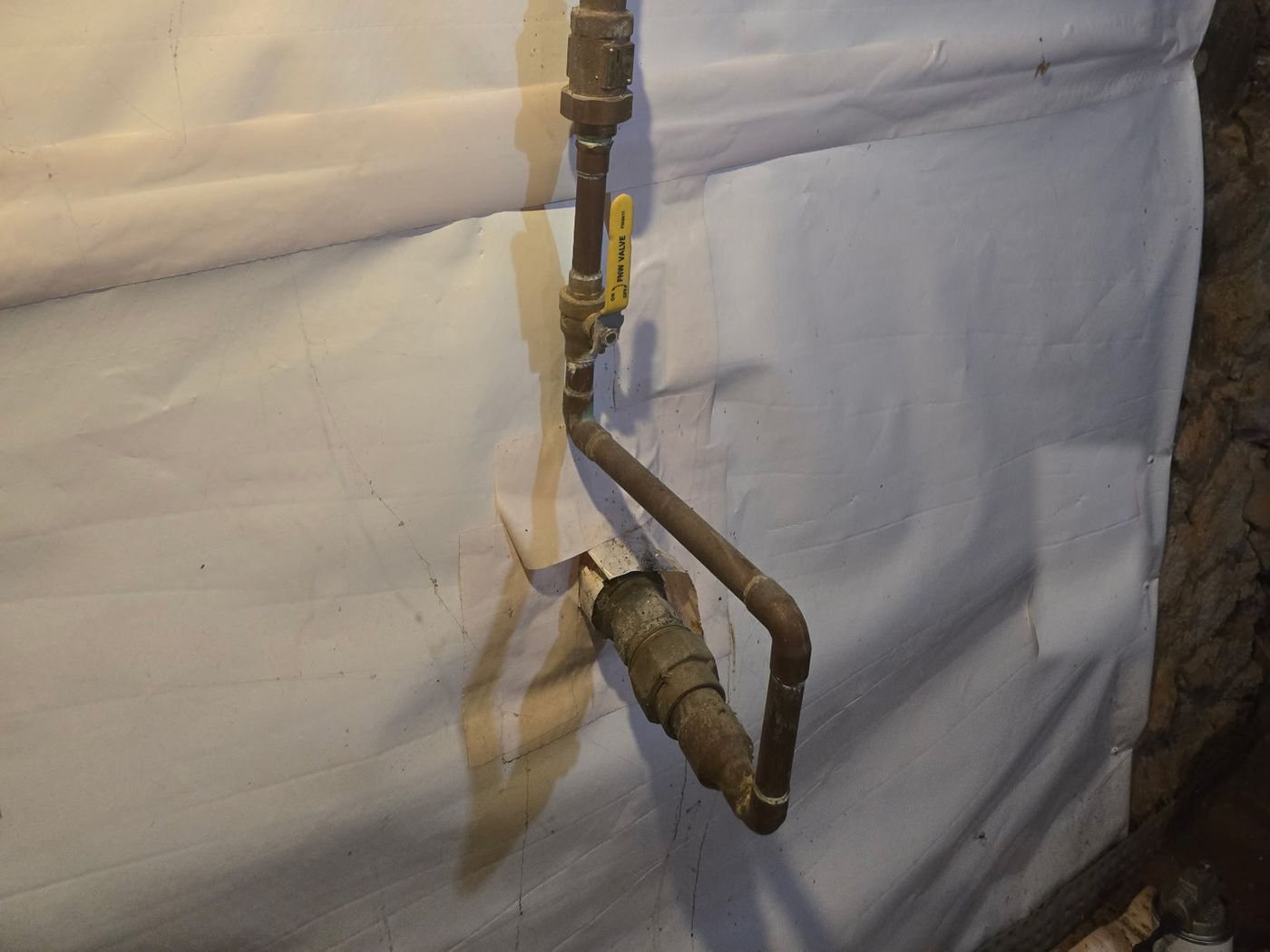
- Service line · material at entrygalvanized (possible)AI suggested
- Service line · fitting at entrybrass couplingAI suggested
- Building piping · materialcopperHuman verified