Inspectial
- Inspectial
- Free checklists
- Culverts
Culvert inspection checklist
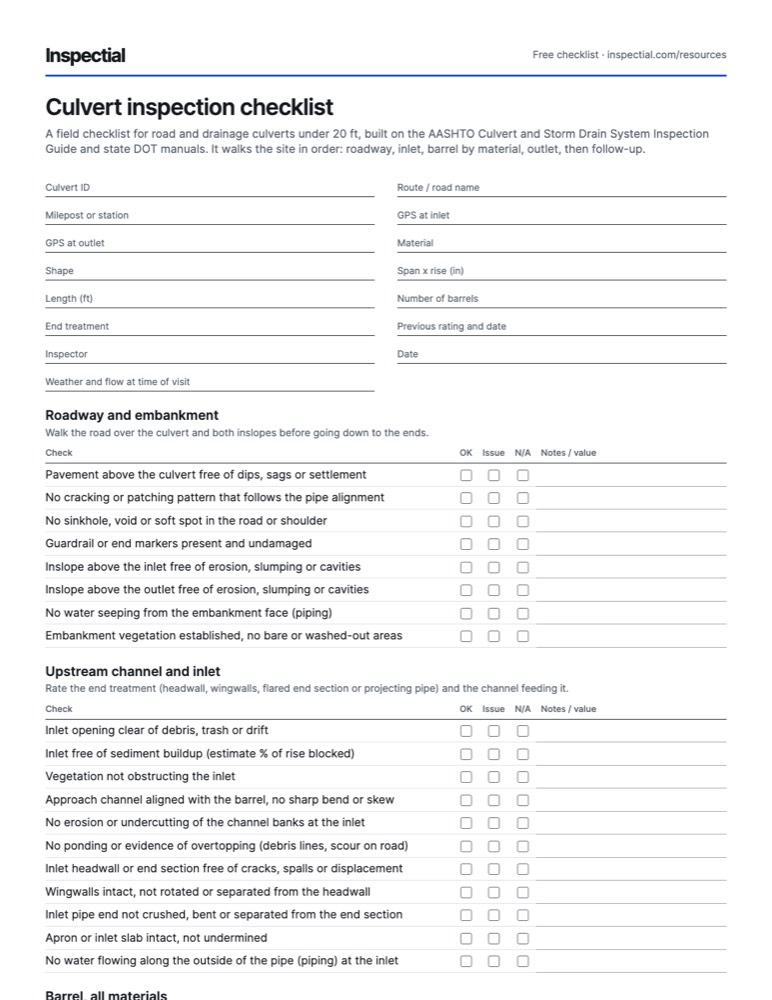
A field checklist for road and drainage culverts under 20 ft, built on the AASHTO Culvert and Storm Drain System Inspection Guide and state DOT manuals. It walks the site in order: roadway, inlet, barrel by material, outlet, then follow-up.
What is a culvert inspection checklist?
A culvert inspection checklist is a field form for rating a culvert's structural and hydraulic condition. The inspector checks the roadway and embankment above, the inlet, the barrel from each end, the joints and the outlet, records defects such as cracking, corrosion, deformation, sediment and scour, and assigns a condition rating where the worst defect controls.
When to inspect
There is no federal inspection interval for culverts under 20 ft: the AASHTO guide leaves frequency to each owner, and most state DOTs run cycles of 5 years or longer. MnDOT, for example, re-inspects culverts rated 1–2 every 6 years, rated 3 every 2–4 years (2 with piping or a road void) and rated 4 every 1–2 years. Culverts over 20 ft span are NBIS bridges, inspected at least every 24 months. Also inspect after floods and high-water events.
The checklist
Every row is one observable check. Mark one answer per row and write what you saw or measured; the PDF adds a findings table and sign-off.
Header
- Culvert ID
- Route / road name
- Milepost or station
- GPS at inlet
- GPS at outlet
- Material
- Shape
- Span x rise (in)
- Length (ft)
- Number of barrels
- End treatment
- Previous rating and date
- Inspector
- Date
- Weather and flow at time of visit
Roadway and embankment
Walk the road over the culvert and both inslopes before going down to the ends.
| Check | OK | Issue | N/A | Notes / value |
|---|---|---|---|---|
| Pavement above the culvert free of dips, sags or settlement | ||||
| No cracking or patching pattern that follows the pipe alignment | ||||
| No sinkhole, void or soft spot in the road or shoulder | ||||
| Guardrail or end markers present and undamaged | ||||
| Inslope above the inlet free of erosion, slumping or cavities | ||||
| Inslope above the outlet free of erosion, slumping or cavities | ||||
| No water seeping from the embankment face (piping) | ||||
| Embankment vegetation established, no bare or washed-out areas |
Upstream channel and inlet
Rate the end treatment (headwall, wingwalls, flared end section or projecting pipe) and the channel feeding it.
| Check | OK | Issue | N/A | Notes / value |
|---|---|---|---|---|
| Inlet opening clear of debris, trash or drift | ||||
| Inlet free of sediment buildup (estimate % of rise blocked) | ||||
| Vegetation not obstructing the inlet | ||||
| Approach channel aligned with the barrel, no sharp bend or skew | ||||
| No erosion or undercutting of the channel banks at the inlet | ||||
| No ponding or evidence of overtopping (debris lines, scour on road) | ||||
| Inlet headwall or end section free of cracks, spalls or displacement | ||||
| Wingwalls intact, not rotated or separated from the headwall | ||||
| Inlet pipe end not crushed, bent or separated from the end section | ||||
| Apron or inlet slab intact, not undermined | ||||
| No water flowing along the outside of the pipe (piping) at the inlet |
Barrel, all materials
Look through the barrel from each end with a flashlight. Record what is not visible rather than guessing.
| Check | OK | Issue | N/A | Notes / value |
|---|---|---|---|---|
| Barrel visible end to end (note the length you could not see) | ||||
| Line and grade straight, no sags, kinks or vertical misalignment | ||||
| Sediment depth in barrel (record % of rise) | ||||
| Debris or blockage inside the barrel | ||||
| Joints closed, no separation (record widest gap in inches) | ||||
| Joints aligned, no offset between sections | ||||
| No soil or water infiltrating through joints | ||||
| No holes or perforations through the wall | ||||
| Invert intact, no section loss or wear through |
Barrel, concrete (RCP, box, arch)
Use for reinforced concrete pipe, cast-in-place boxes and precast arches.
| Check | OK | Issue | N/A | Notes / value |
|---|---|---|---|---|
| Cracks below 0.01 in, or none (record width and direction of the widest) | ||||
| No longitudinal cracks at the crown or invert | ||||
| No spalling or delamination | ||||
| No exposed or corroded reinforcing steel | ||||
| No efflorescence or rust staining at cracks | ||||
| No slabbing or shear cracking near the springline | ||||
| No scaling or abrasion of the invert |
Barrel, corrugated metal (CMP)
Use for corrugated steel and aluminum pipe and structural plate.
| Check | OK | Issue | N/A | Notes / value |
|---|---|---|---|---|
| Coating intact, no loss at the waterline or invert | ||||
| Corrosion no worse than surface rust (note freckled, pitting or through-wall) | ||||
| Invert free of section loss or perforation | ||||
| Shape round, deformation below 5% of diameter (record estimate) | ||||
| No dents, buckling or flattening at the crown | ||||
| Seams and bolts intact, no cracking or seam separation |
Barrel, plastic (HDPE, PVC)
Use for corrugated polyethylene and PVC pipe.
| Check | OK | Issue | N/A | Notes / value |
|---|---|---|---|---|
| Deflection below 5% of diameter (record estimate) | ||||
| No local buckling, rippling or wall crushing | ||||
| No splits or cracks in the wall or liner | ||||
| Exposed ends free of UV damage, fire damage or brittleness | ||||
| Pipe not floated or lifted out of grade |
Outlet and downstream channel
Scour usually shows here first. Probe the outlet pool and the toe of any apron.
| Check | OK | Issue | N/A | Notes / value |
|---|---|---|---|---|
| Outlet opening clear of debris and sediment | ||||
| Outlet headwall or end section free of cracks, spalls or displacement | ||||
| Outlet pipe end not crushed, bent or separated | ||||
| Apron or energy dissipator intact, not undermined | ||||
| No scour hole at the outlet (record depth if present) | ||||
| Outlet not perched above the downstream water surface (record drop) | ||||
| Riprap in place, not displaced or washed out | ||||
| Downstream channel banks stable, no active erosion | ||||
| No water flowing along the outside of the pipe (piping) at the outlet |
Rating and follow-up
Answer before leaving the site. Cleaning need is recorded separately from structural condition.
| Check | Yes | No | N/A | Notes / value |
|---|---|---|---|---|
| Immediate hazard found (road void, collapse, washout) and reported by phone | ||||
| Cleaning or debris removal needed | ||||
| Further inspection needed (pole camera, CCTV crawler or confined-space entry) | ||||
| Repair or replacement recommended | ||||
| Culvert is a likely barrier to fish or wildlife passage | ||||
| Inventory data corrected (material, size, length or ID) |
Condition rating (worst defect controls)
Rate the asset by its worst defect, best to worst.
- 1 Good
- Functions as designed. Minor, isolated defects at most; RCP cracks up to 0.01 in, CMP deformation under 5%.
- 2 Fair
- Moderate defects that don't yet threaten structure or flow: RCP cracks 0.01–0.05 in, CMP deformation 5–10%. Monitor or schedule maintenance.
- 3 Poor
- Significant defects affecting structure or hydraulics: section loss, open joints, active scour, RCP cracks 0.05–0.1 in, CMP deformation 10–15%. Repair needed.
- 4 Severe
- Failure or imminent failure: collapse, perforation with soil loss, full blockage, RCP cracks over 0.1 in or offset, CMP deformation over 15%. Act now.
Photos to take
- Road surface over the culvert, looking along the road in both directions
- Inlet end treatment, straight on
- Upstream channel, looking upstream from the inlet
- Barrel interior from the inlet
- Barrel interior from the outlet
- Outlet end treatment, straight on
- Downstream channel, looking downstream from the outlet
- Close-up of each defect rated Fair or worse, with a scale reference
Field tips
- Rate each component, then take the worst one as the overall rating. A sound barrel does not offset a scoured outlet.
- Record sediment and debris as a cleaning need, not as structural condition, so a dirty pipe isn't mistaken for a failing one.
- Photograph a ruler, tape or pen next to cracks and joint gaps; a width estimate without scale is hard to review later.
- Look for piping at both ends: water running outside the pipe is the usual cause of road voids, and it is easy to miss in low flow.
- If you can't see the full barrel, record the unseen length and recommend a camera instead of rating what you didn't see.
- Never enter a culvert without a confined-space permit, an attendant and atmospheric monitoring.
- Confirm the culvert ID and GPS at the inlet before you start; mismatched IDs are a common inventory error.
Standards and sources
Checked against these sources on . Your agency's own manual takes precedence.
Questions
How often should culverts be inspected?
Culverts under 20 ft span have no federal inspection interval, so the owner sets it. Most state DOTs run cycles of 5 years or longer, with poor culverts more often; MnDOT re-inspects culverts rated 4 every 1–2 years. Culverts over 20 ft are bridges under the NBIS and need an inspection at least every 24 months.
What rating scale is used for culvert inspection?
The AASHTO Culvert and Storm Drain System Inspection Guide uses 1 Good, 2 Fair, 3 Poor and 4 Severe for each characteristic, and the worst one becomes the component rating. Bridge-length culverts are also rated 0–9 under the NBI and SNBI. Many state DOTs, such as Ohio, keep their own 0–9 or 1–4 scale.
What should a culvert inspection report include?
At minimum: culvert ID, location and GPS, material, shape, size and length, a rating for the inlet, barrel, joints and outlet, the overall rating, sediment and debris levels, any scour or piping, recommended actions, and photos of both ends and the barrel. Most agencies now want this as rows in a GIS layer, not only as a PDF.
Can you inspect a culvert without entering it?
Yes. Standard practice for small culverts is to rate them from the pipe ends with a flashlight, estimating defects from what is visible. If the barrel is too long, too small or too dark to see, use a pole camera or CCTV crawler. Entry is a confined-space operation and needs a permit, an attendant and gas monitoring.
What is the difference between culvert condition and cleaning need?
Condition describes the structure: cracking, corrosion, deformation, joints and scour. Cleaning need describes sediment and debris that reduce capacity. MnDOT records them separately so that a culvert full of sediment but structurally sound is scheduled for maintenance, not replacement.
When is a culvert considered a bridge?
Under the NBIS, a structure with an opening over 20 ft measured along the roadway centerline is a bridge. That includes multiple pipes whose combined openings exceed 20 ft when the clear distance between them is less than half the smaller opening. Some states use lower thresholds, such as 10 ft in Minnesota, and Ontario applies OSIM to culverts with a span of 3 m or more.
Do this inspection on your phone: AI drafts it, you approve
Inspectial turns the photos, voice notes and GPS from this checklist into a structured, map-ready inspection record. Every finding links to its photo, and nothing is official until you approve it.
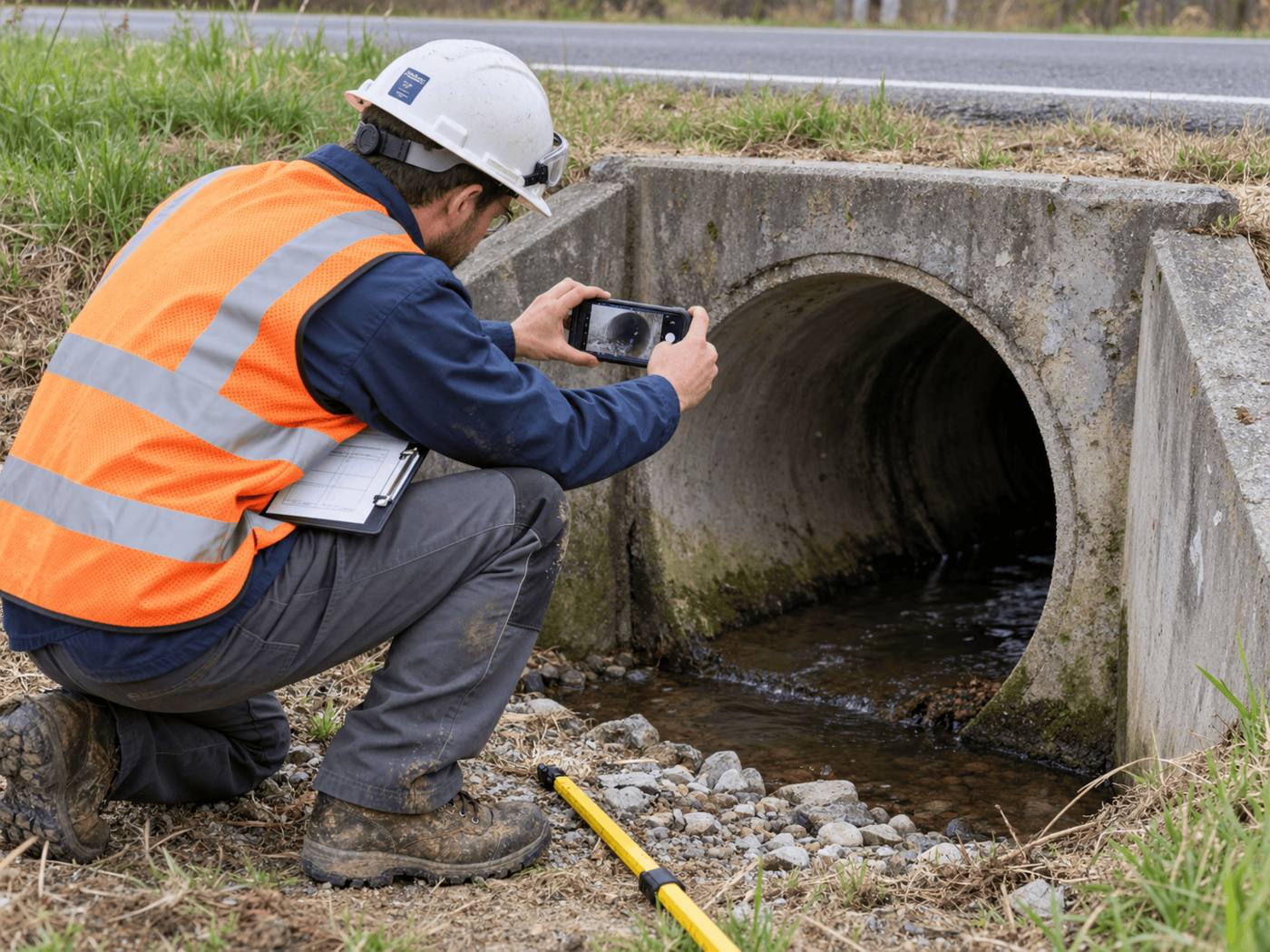
- Headwall · surfaceweatheringAI suggested
- Barrel · surfacestainingAI suggested
- Barrel · vegetationmoss at wall baseAI suggested