Inspectial
SWPPP inspection form
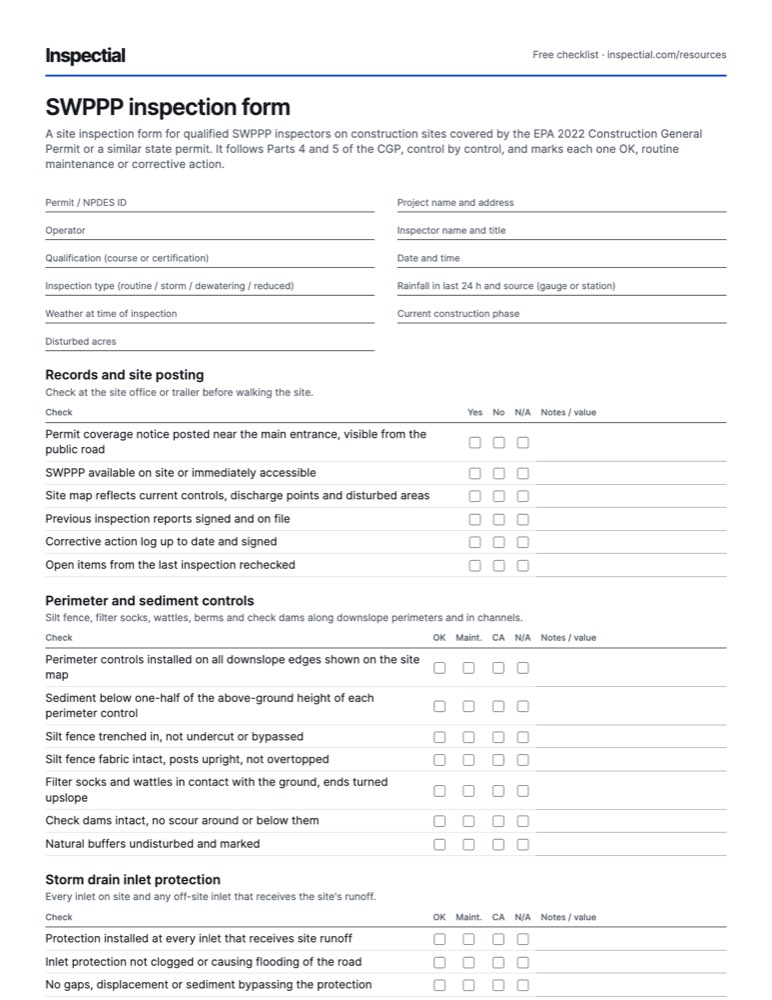
A site inspection form for qualified SWPPP inspectors on construction sites covered by the EPA 2022 Construction General Permit or a similar state permit. It follows Parts 4 and 5 of the CGP, control by control, and marks each one OK, routine maintenance or corrective action.
What is a SWPPP inspection form?
A SWPPP inspection form is the report a qualified inspector completes on a permitted construction site to show that erosion, sediment and pollution prevention controls are installed, working and maintained. It records the inspection date and trigger, findings for each control, any discharges, and the routine maintenance or corrective actions needed, and must be signed.
When to inspect
Under Part 4.2 of the EPA 2022 CGP, inspect at least once every 7 calendar days, or once every 14 calendar days plus within 24 hours of a storm producing 0.25 in of rain in 24 hours (or a snowmelt discharge from 3.25 in of snow). Sites discharging to sediment- or nutrient-impaired or Tier 2, 2.5 or 3 waters must do both (Part 4.3). Complete the report within 24 hours of the inspection (Part 4.7.1). State permits differ: California requires weekly inspections plus pre-, during- and post-event inspections for qualifying rain.
The checklist
Every row is one observable check. Mark one answer per row and write what you saw or measured; the PDF adds a findings table and sign-off.
Header
- Permit / NPDES ID
- Project name and address
- Operator
- Inspector name and title
- Qualification (course or certification)
- Date and time
- Inspection type (routine / storm / dewatering / reduced)
- Rainfall in last 24 h and source (gauge or station)
- Weather at time of inspection
- Current construction phase
- Disturbed acres
Records and site posting
Check at the site office or trailer before walking the site.
| Check | Yes | No | N/A | Notes / value |
|---|---|---|---|---|
| Permit coverage notice posted near the main entrance, visible from the public road | ||||
| SWPPP available on site or immediately accessible | ||||
| Site map reflects current controls, discharge points and disturbed areas | ||||
| Previous inspection reports signed and on file | ||||
| Corrective action log up to date and signed | ||||
| Open items from the last inspection rechecked |
Perimeter and sediment controls
Silt fence, filter socks, wattles, berms and check dams along downslope perimeters and in channels.
| Check | OK | Maint. | CA | N/A | Notes / value |
|---|---|---|---|---|---|
| Perimeter controls installed on all downslope edges shown on the site map | |||||
| Sediment below one-half of the above-ground height of each perimeter control | |||||
| Silt fence trenched in, not undercut or bypassed | |||||
| Silt fence fabric intact, posts upright, not overtopped | |||||
| Filter socks and wattles in contact with the ground, ends turned upslope | |||||
| Check dams intact, no scour around or below them | |||||
| Natural buffers undisturbed and marked |
Storm drain inlet protection
Every inlet on site and any off-site inlet that receives the site's runoff.
| Check | OK | Maint. | CA | N/A | Notes / value |
|---|---|---|---|---|---|
| Protection installed at every inlet that receives site runoff | |||||
| Inlet protection not clogged or causing flooding of the road | |||||
| No gaps, displacement or sediment bypassing the protection | |||||
| Sediment removed from around the inlet |
Construction exits and track-out
| Check | OK | Maint. | CA | N/A | Notes / value |
|---|---|---|---|---|---|
| Vehicles leaving only at designated, stabilized exits | |||||
| Exit stone or mats in place and not clogged with sediment | |||||
| No sediment tracked onto paved roads or sidewalks | |||||
| Track-out removed by sweeping or vacuuming, not hosed into drains |
Stabilization and slopes
Stabilization must begin immediately where work has stopped for 14 or more days (CGP Part 2.2.14).
| Check | OK | Maint. | CA | N/A | Notes / value |
|---|---|---|---|---|---|
| Inactive areas stabilized or stabilization started on time | |||||
| No rills or gullies on slopes or exposed soil | |||||
| Erosion control blankets and matting in place and anchored | |||||
| Seeded areas showing vegetation, no washouts | |||||
| Stockpiles covered or stabilized, with a sediment barrier downslope | |||||
| Dust controlled on exposed soil and haul roads | |||||
| Diversions and swales stable, not eroding |
Sediment basins, traps and dewatering
Dewatering discharges need their own inspection record (CGP Part 4.6.3).
| Check | OK | Maint. | CA | N/A | Notes / value |
|---|---|---|---|---|---|
| Sediment basin at or above one-half of design capacity | |||||
| Basin outlet and skimmer working, not clogged | |||||
| Basin embankment and spillway stable, no erosion or seepage | |||||
| Dewatering water routed through a treatment control before discharge | |||||
| Dewatering discharge free of a sediment plume, sheen or foam | |||||
| Treatment chemicals stored and used as the SWPPP describes |
Pollution prevention and materials
| Check | OK | Maint. | CA | N/A | Notes / value |
|---|---|---|---|---|---|
| Concrete washout in use, not full and not leaking | |||||
| No concrete, paint or stucco washwater on bare ground or in drains | |||||
| Fuel and chemicals stored with secondary containment or cover | |||||
| Fueling and maintenance areas free of leaks and stained soil | |||||
| Spill kit present and stocked | |||||
| Dumpsters covered or lidded, not leaking | |||||
| Portable toilets secured so they cannot be tipped over | |||||
| Building materials stored to prevent contact with stormwater |
Discharge points and receiving waters
Answer for every discharge point on the site map. A yes in the last five rows needs corrective action.
| Check | Yes | No | N/A | Notes / value |
|---|---|---|---|---|
| All discharge points inspected | ||||
| Discharge occurring at the time of inspection | ||||
| Sediment deposits or sand bars visible below discharge points | ||||
| Turbid, discolored or foamy water at a discharge point | ||||
| Oil sheen or odor at a discharge point | ||||
| Floating or settled solids in the receiving water | ||||
| Sediment on streets, curbs or off-site channels attributable to the site |
Follow-up and signature
| Check | Yes | No | N/A | Notes / value |
|---|---|---|---|---|
| Routine maintenance items listed with location and due date | ||||
| Corrective actions entered in the log within 24 hours | ||||
| Same control repaired 3 or more times flagged as corrective action | ||||
| Locations where new or modified controls are needed recorded | ||||
| Areas unsafe to inspect described with the reason | ||||
| SWPPP and site map changes noted for update | ||||
| Report signed by the operator's signatory |
BMP result codes
- OK
- Installed, operational and working as intended.
- Maint.
- Routine maintenance: remove sediment, re-stake, clean or patch. EPA CGP Part 2.1.4 expects it done by the close of the next business day, or within 7 calendar days if that is infeasible.
- CA
- Corrective action: significant repair, a new or replacement control, a control never installed or installed wrong, or the same fix needed 3 or more times. Log within 24 hours and complete within 7 calendar days (CGP Part 5).
- N/A
- The control is not on site or not required at this phase. Say why in the notes.
Photos to take
- Permit sign at the entrance
- Each construction exit and the adjoining paved road
- Each inlet protection device
- Perimeter controls at the lowest point of each drainage area
- Every control marked maintenance or corrective action, before the fix
- Each discharge point, and the receiving water if flowing
- Stabilized areas, dated, for the Notice of Termination record
- Dewatering water before and after treatment, the control and the discharge point
Field tips
- Write each finding with a location the crew can find again: station, grid or a map ID, not just "east side".
- Record the rain gauge or weather station reading for every storm-triggered inspection; the report must include it.
- Count repeats. The third time the same control at the same spot needs the same fix, it becomes a corrective action under CGP Part 5.1.1.
- Inspect off-site inlets and the street at the exit too; sediment that left the site is what regulators and neighbors notice.
- Take the follow-up photo after the repair; a before photo alone does not show the corrective action was completed.
- Check your state permit: many states run their own CGP with different triggers, forms and inspector credentials.
Standards and sources
Checked against these sources on . Your agency's own manual takes precedence.
Questions
How often do SWPPP inspections need to be done?
Under the EPA 2022 CGP, at least once every 7 calendar days, or once every 14 days plus within 24 hours of 0.25 in of rain. Sites draining to impaired or high-quality waters must do both. Stabilized, arid or frozen sites can qualify for reduced frequency, as low as monthly.
Who can perform a SWPPP inspection?
The EPA CGP requires a qualified person who has completed the EPA construction inspection training and exam, or holds a current certification covering the same material. Common certifications include CESSWI and CPESC. States set their own rules, such as QSP and QSD in California.
What must a SWPPP inspection report include?
Under CGP Part 4.7.1: the inspection date, the names and titles of the inspectors, a summary of findings including any routine maintenance or corrective action needed, the rain or snow data for storm-triggered inspections, and any areas unsafe to inspect. It must be completed within 24 hours and signed.
What is the difference between routine maintenance and corrective action?
Routine maintenance keeps a working control effective, such as removing sediment, and is due by the close of the next business day. Corrective action covers significant repairs, missing or wrongly installed controls, permit violations, and any routine fix needed 3 or more times. It must be logged within 24 hours and generally completed within 7 calendar days.
How long do I keep SWPPP inspection reports?
The EPA CGP requires you to keep inspection reports and the corrective action log for at least 3 years after permit coverage expires or is terminated. Reports must be available on site or easily accessible, and electronic records are allowed if they are as readable and dependable as paper.
Do I need photos in a SWPPP inspection?
The EPA CGP requires photos for dewatering inspections and dated photos of stabilized areas with the Notice of Termination. California requires photographs at every weekly inspection. Even where not required, photos of each deficient control before and after the fix are the easiest proof of compliance.
Do this inspection on your phone: AI drafts it, you approve
Inspectial turns the photos, voice notes and GPS from this checklist into a structured, map-ready inspection record. Every finding links to its photo, and nothing is official until you approve it.
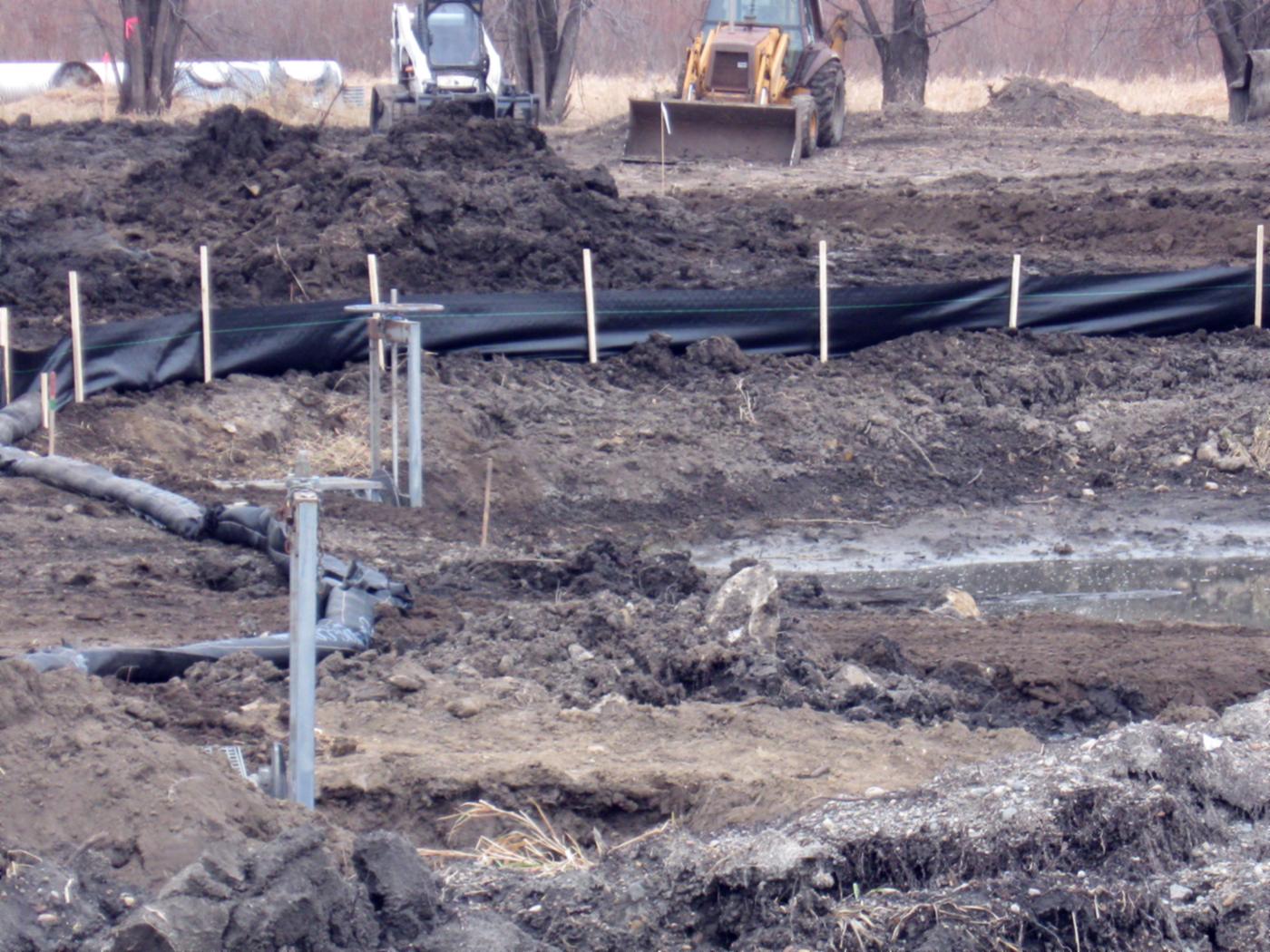
- Stockpile · coveruncoveredAI suggested
- Silt fence · conditionfabric intact, posts uprightHuman verified
- Silt fence · sedimentbelow ½ fence heightHuman verified