Inspectial
- Inspectial
- Free checklists
- Utility poles
Utility pole inspection checklist
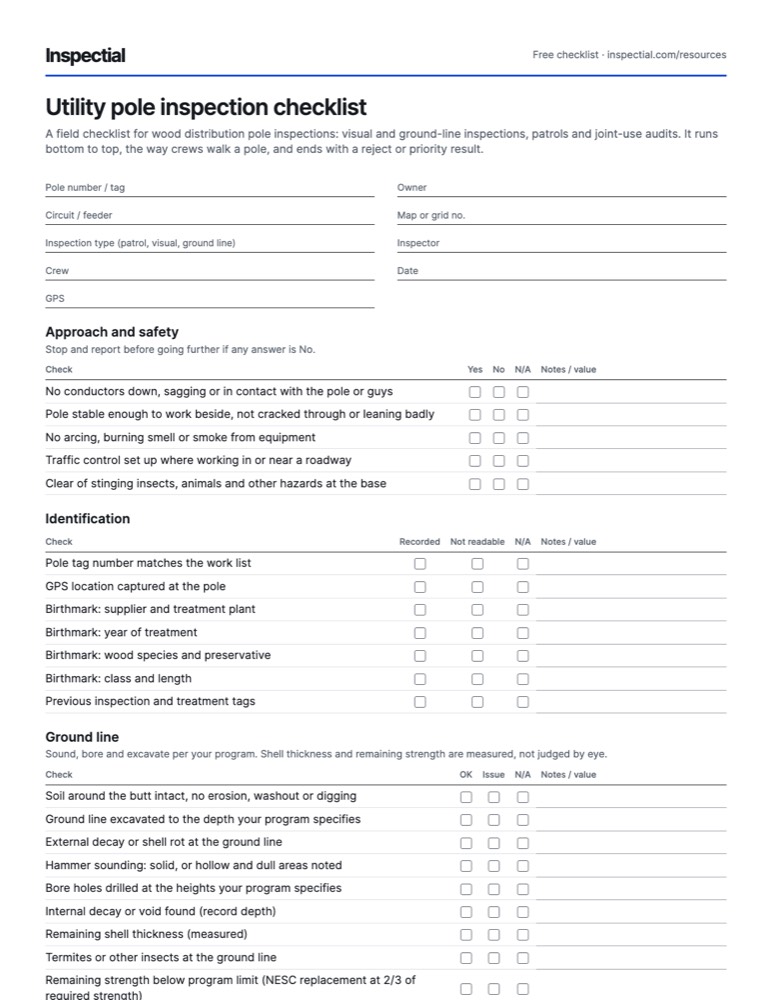
A field checklist for wood distribution pole inspections: visual and ground-line inspections, patrols and joint-use audits. It runs bottom to top, the way crews walk a pole, and ends with a reject or priority result.
What is a utility pole inspection checklist?
A utility pole inspection checklist is the field form a crew uses to record the condition of a wood pole: its tag and birthmark, ground-line decay from sounding and boring, damage to the pole body, crossarms and hardware, guys and anchors, attachments and clearances. Each pole ends with a pass, maintenance, reject or priority reject result.
When to inspect
NESC Rule 214 requires lines to be inspected at intervals experience shows to be necessary, so cycles are set by state regulators and utility programs. Florida requires an 8-year cycle for investor-owned utilities, Pennsylvania 10 to 12 years (52 Pa. Code §57.198), and California GO 165 a 10-year intrusive inspection for poles over 15 years old. RUS Bulletin 1730B-121 ties cycle length to the local decay zone.
The checklist
Every row is one observable check. Mark one answer per row and write what you saw or measured; the PDF adds a findings table and sign-off.
Header
- Pole number / tag
- Owner
- Circuit / feeder
- Map or grid no.
- Inspection type (patrol, visual, ground line)
- Inspector
- Crew
- Date
- GPS
Approach and safety
Stop and report before going further if any answer is No.
| Check | Yes | No | N/A | Notes / value |
|---|---|---|---|---|
| No conductors down, sagging or in contact with the pole or guys | ||||
| Pole stable enough to work beside, not cracked through or leaning badly | ||||
| No arcing, burning smell or smoke from equipment | ||||
| Traffic control set up where working in or near a roadway | ||||
| Clear of stinging insects, animals and other hazards at the base |
Identification
| Check | Recorded | Not readable | N/A | Notes / value |
|---|---|---|---|---|
| Pole tag number matches the work list | ||||
| GPS location captured at the pole | ||||
| Birthmark: supplier and treatment plant | ||||
| Birthmark: year of treatment | ||||
| Birthmark: wood species and preservative | ||||
| Birthmark: class and length | ||||
| Previous inspection and treatment tags |
Ground line
Sound, bore and excavate per your program. Shell thickness and remaining strength are measured, not judged by eye.
| Check | OK | Issue | N/A | Notes / value |
|---|---|---|---|---|
| Soil around the butt intact, no erosion, washout or digging | ||||
| Ground line excavated to the depth your program specifies | ||||
| External decay or shell rot at the ground line | ||||
| Hammer sounding: solid, or hollow and dull areas noted | ||||
| Bore holes drilled at the heights your program specifies | ||||
| Internal decay or void found (record depth) | ||||
| Remaining shell thickness (measured) | ||||
| Termites or other insects at the ground line | ||||
| Remaining strength below program limit (NESC replacement at 2/3 of required strength) | ||||
| Remedial treatment applied, with product recorded | ||||
| Bore holes plugged and excavation backfilled and tamped |
Pole body
| Check | OK | Issue | N/A | Notes / value |
|---|---|---|---|---|
| Lean within program limit (measured) | ||||
| Woodpecker holes | ||||
| Splits through the pole | ||||
| Checks wide or deep enough to hold water | ||||
| Shell rot or soft spots above ground line | ||||
| Vehicle or mechanical damage | ||||
| Fire or lightning damage | ||||
| Climbing obstructions: nails, staples, signs, vines |
Pole top, crossarm and hardware
From the ground with binoculars unless the program says otherwise.
| Check | OK | Issue | N/A | Notes / value |
|---|---|---|---|---|
| Pole top decay, splitting or missing cap | ||||
| Crossarm decayed or split | ||||
| Crossarm broken or sagging | ||||
| Crossarm braces intact | ||||
| Insulators chipped, broken or flashed | ||||
| Bolts, pins and ties tight, nothing missing | ||||
| Cutouts and arresters intact | ||||
| Transformer leaking oil, rusted or bulging | ||||
| Ground wire and molding intact | ||||
| Bird nests on equipment |
Guys and anchors
| Check | OK | Issue | N/A | Notes / value |
|---|---|---|---|---|
| Guy wire tight, not slack | ||||
| Guy strands broken or corroded | ||||
| Guy guard present and visible | ||||
| Guy insulator intact where required | ||||
| Anchor rod corroded or exposed | ||||
| Anchor pulled or pulling out |
Attachments, clearances and vegetation
Heights and separations are measured with a height stick or laser, not read from a photo.
| Check | OK | Issue | N/A | Notes / value |
|---|---|---|---|---|
| Number of attachments counted | ||||
| Each attachment tagged with its owner | ||||
| Unauthorized or untagged attachments | ||||
| Communication-to-power separation within NESC limits (measured) | ||||
| Conductor clearance over road or ground within NESC limits (measured) | ||||
| Risers and conduit secured to the pole | ||||
| Climbing space clear | ||||
| Streetlight and bracket secure | ||||
| Vegetation in contact with conductors or the pole | ||||
| Old pole left standing next to a new one (double wood) |
Reject and priority codes
- Pass
- No reject criteria found. Recorded with photos for the next cycle.
- Maintenance
- The pole is serviceable, but an item needs follow-up: a slack guy, a missing guy guard, loose hardware or vegetation.
- Restorable reject
- Fails the strength criteria but can be reinforced or treated instead of replaced.
- Reject
- Replace on the utility's normal reject schedule.
- Priority reject
- Immediate risk to the public, workers or the circuit. Make safe and replace first.
Photos to take
- Full pole from the ground, top to butt, from two sides roughly 90° apart
- Pole tag, close enough to read the number
- Birthmark, close enough to read each line
- Ground line, before and after excavation
- Bore holes or shell readings with the tool in frame
- Pole top and crossarm, zoomed in
- Each defect, with a wide shot for location
- Guys, anchors and guy guards
- Attachments, risers and any clearance issue
Field tips
- Read the birthmark before excavating. On standard poles it sits about 10 ft above the butt, or 14 ft on poles over 50 ft, and soil or growth soon covers it.
- Cedar and other species often decay from the inside out. A sound-looking surface is not a pass; trust the hammer and the drill.
- Measure lean with a level or app, and photograph it from two sides. A single photo can hide or exaggerate lean.
- Record 'not readable' for a worn tag or birthmark instead of guessing. A wrong pole number is worse than a blank.
- Flag priority rejects to dispatch before you leave the pole, not at the end of the day.
- Write one defect per row, with the component, so the reject code is traceable to the evidence.
Standards and sources
Checked against these sources on . Your agency's own manual takes precedence.
Questions
How often are utility poles inspected?
There is no single national interval: NESC Rule 214 leaves it to experience, and state regulators set the cycle. Florida requires 8 years for investor-owned utilities, Pennsylvania 10 to 12 years, and California a 10-year intrusive inspection for wood poles over 15 years old plus 5-year detailed inspections and annual patrols. RUS Bulletin 1730B-121 recommends shorter cycles in more severe decay zones.
What is a ground-line inspection?
An intrusive check at and below the soil line, where wood poles decay fastest. The crew excavates around the base, sounds the pole with a hammer, bores it to find internal decay and measure the remaining shell, then applies remedial treatment and backfills. The result decides pass, treat, reinforce or replace.
What information is on a pole birthmark?
The birthmark (brand) shows the supplier and treatment plant, the year of treatment, the wood species and preservative, and the pole class and length. It is burned or stamped into the pole above the butt, so it stays above ground after setting. The class and length tell you the pole's rated strength.
When should a wood pole be rejected?
When its remaining strength falls below the utility's limit, typically 2/3 of the required strength under the NESC, or when visible damage makes it unsafe: a broken or cracked-through pole, severe lean or heavy woodpecker damage. A restorable reject can be reinforced with a steel truss; a non-restorable one is replaced. Poles with immediate risk are priority rejects.
What is a joint use audit?
A survey of every attachment on a utility's poles: who owns it, what it is, its height and whether it is authorized. It finds unbilled or unsafe attachments and clearance violations between communication and power lines. Heights must be measured, typically with a height stick or laser.
Can you inspect a wood pole visually only?
A visual inspection finds visible defects such as lean, woodpecker holes, splits, crossarm and hardware damage, but not internal or below-ground decay. That is why programs combine frequent visual patrols with less frequent intrusive ground-line inspections.
Do this inspection on your phone: AI drafts it, you approve
Inspectial turns the photos, voice notes and GPS from this checklist into a structured, map-ready inspection record. Every finding links to its photo, and nothing is official until you approve it.
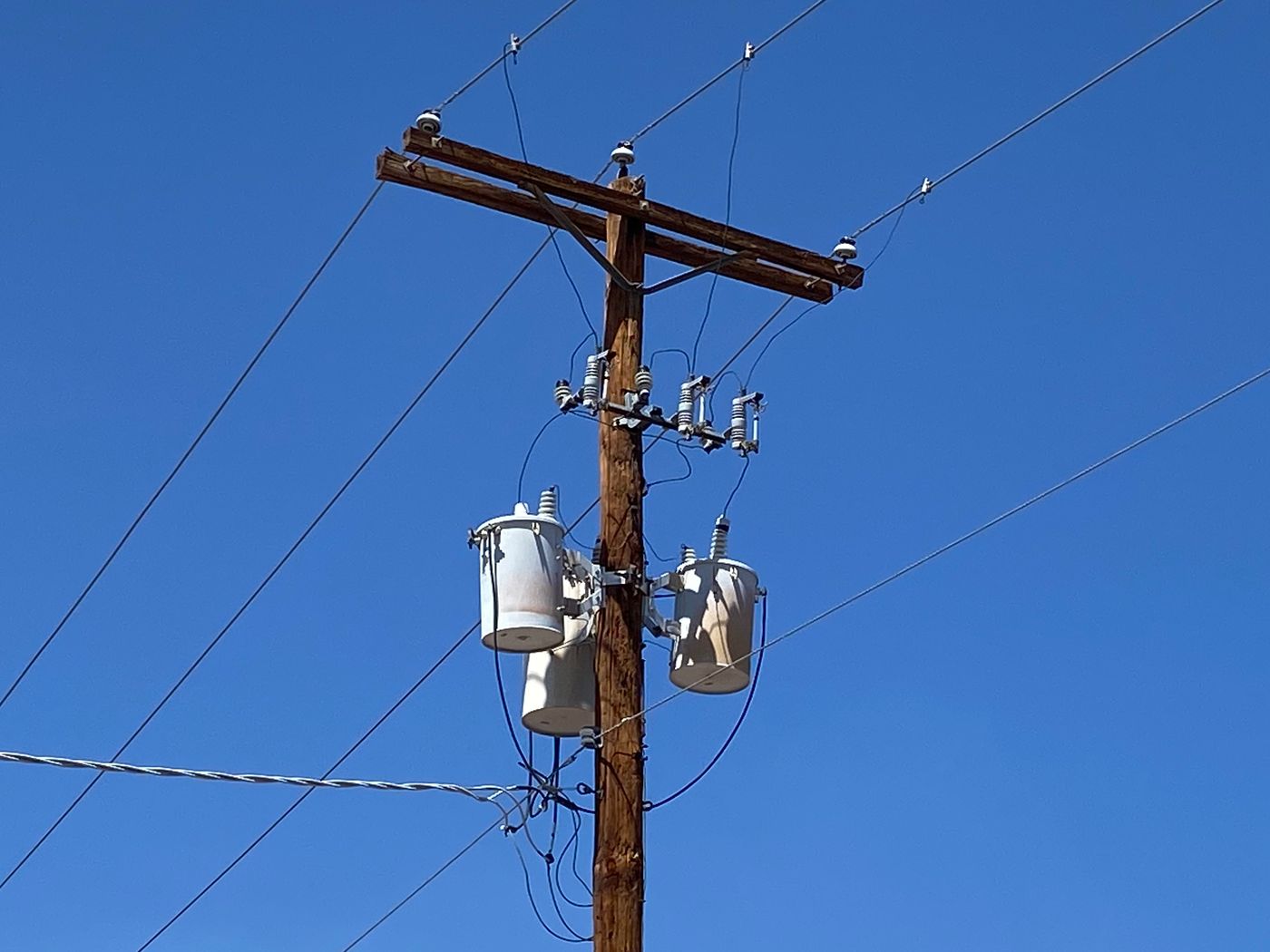
- Crossarm · conditiondouble arm, no visible defectsHuman verified
- Insulator · conditionpin type, no visible damageAI suggested
- Cutouts · conditionno visible damageAI suggested